Maintenance & repair
Underground detention maintenance and repair.
Vaults, arch chamber fields and oversized pipe under the parking lot. Most have not been cleaned since construction. We get in, measure, clean and fix.

01 / The baseline
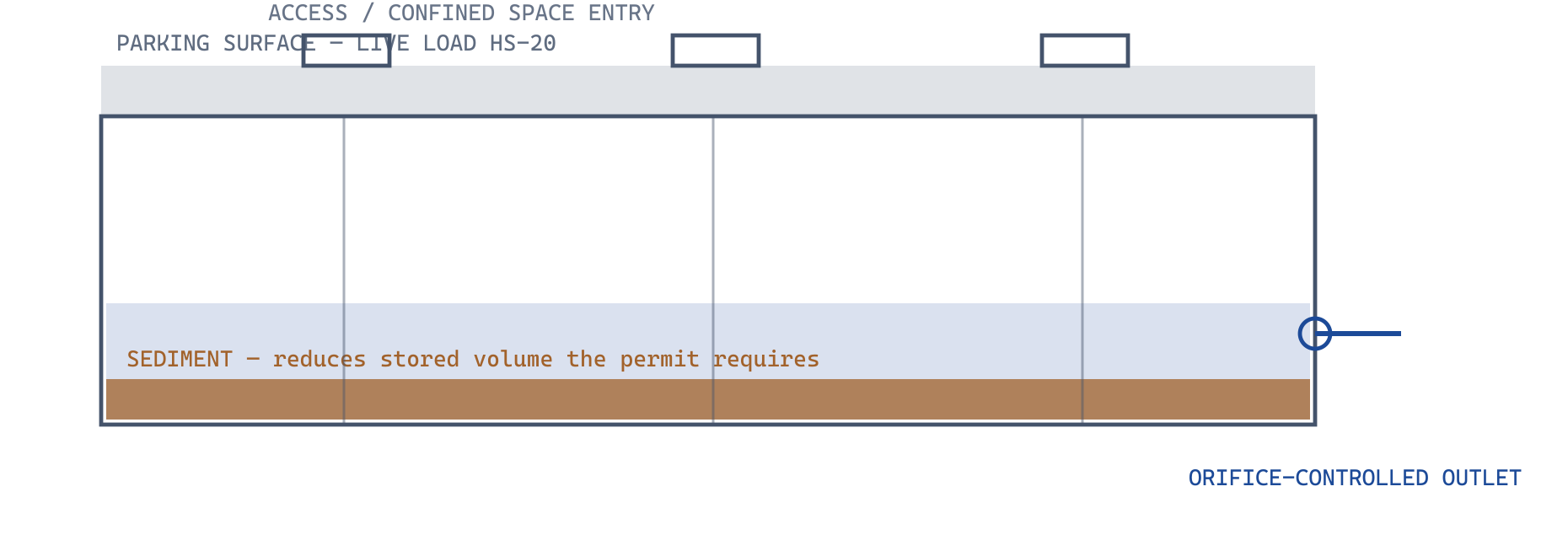
Inspect at least once a year, measuring sediment at every access point. Clean inlet sumps once or twice a year. Remove sediment from the vault, chambers or pipe when it reaches the trigger in the approved plan or the manufacturer’s manual. Keep every hatch accessible. Systems never cleaned since construction often have lost a measurable share of their storage.
Reviewed October 2026.
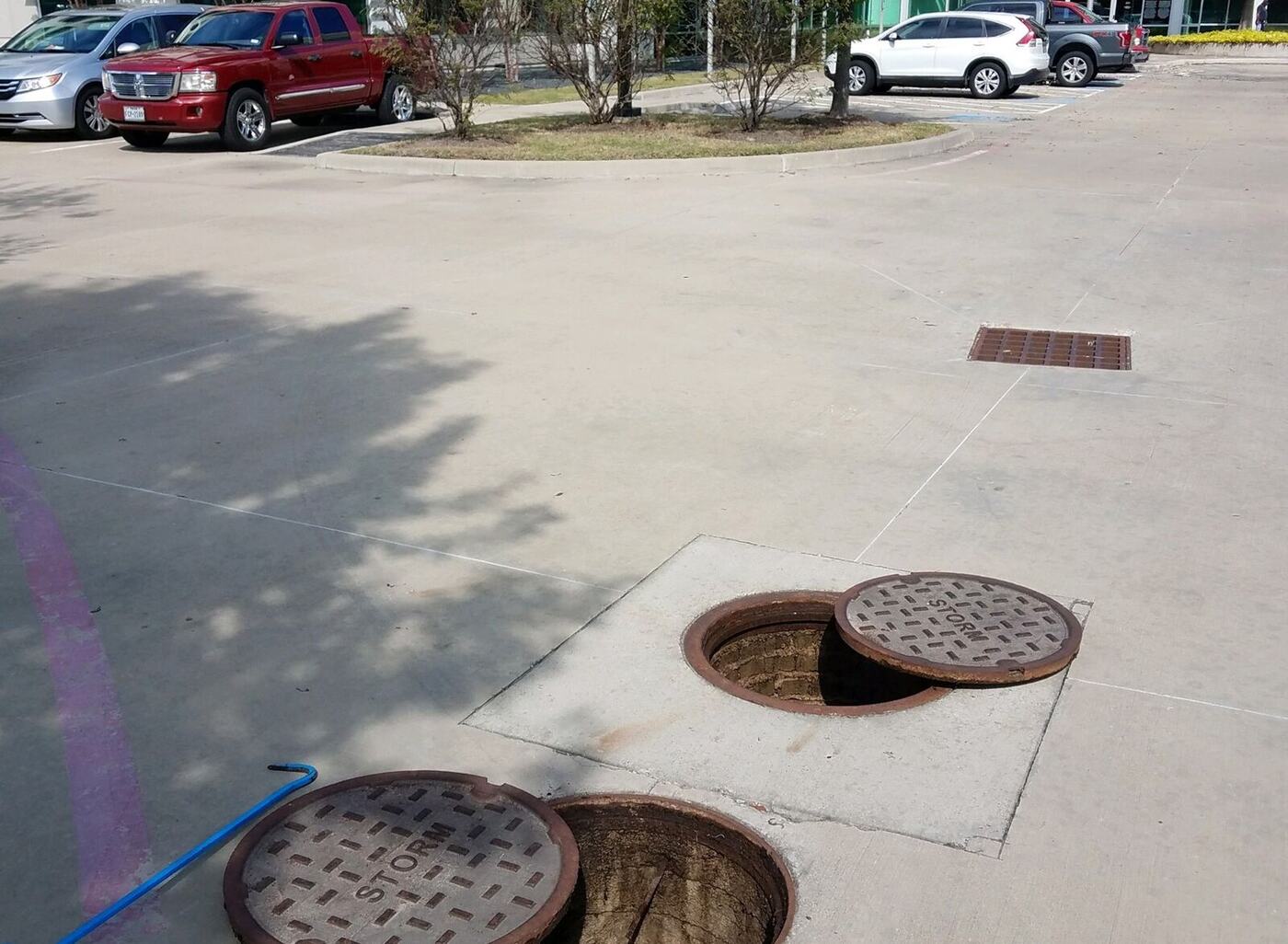
Access points opened for a confined space entry.
02 / Requirements
| Task | Typical frequency | Trigger or standard |
|---|---|---|
| Inspection | 1×/yr; 2× on high-sediment sites | Measured sediment at every access point. |
| Inlet sumps | 1–2×/yr | Cleared before they pass sediment downstream. |
| Sediment removal | When triggered | Per approved plan; isolator rows per manufacturer. |
| Control structure | Every inspection | Orifice and weir clear, matching the design. |
| Access | Every inspection | All hatches located and operable. |
| Structure | Every inspection | Cracks, leaks, joint failures, corrosion. |
03 / How it works
04 / Our method
Measure first. Price second. Document against the standard.
Step 01
Every access point found against the drawings, including buried hatches.
Step 02
Permit-required entry with atmospheric monitoring. Sediment and condition at fixed stations.
Step 03
Vacuum and jetting across the floor, chambers or pipe, including isolator rows.
Step 04
Orifice, weir and outlet back to the approved design.
Step 05
Post-clean measurements, photos at each access point, volume removed, manifests.
05 / Services
06 / Reference
Entry
Permit-required confined space
Inspection
2× on high-sediment sites
Common loss
On systems never cleaned
Access
Not just the easy one
07 / Questions
What to know about underground detention maintenance.
Measure sediment at the access points against the design invert. Warning signs: water standing in the lot after moderate storms, slow drawdown, a downstream structure surcharging.
Yes. It needs a written program, atmospheric monitoring, an attendant and rescue provisions.
Usually. We work access points in stages so only part of a drive aisle is out at a time.
It is dewatered, characterized where site history calls for it, and hauled under manifest to a permitted facility.
08 / Other BMPs