Service
Detention and retention pond maintenance, measured against the adopted standard.
Sediment surveys, forebay and full-basin dredging, slope restoration, outlet repair and vegetation management for wet ponds, dry basins and extended detention.

Service
Sediment surveys, forebay and full-basin dredging, slope restoration, outlet repair and vegetation management for wet ponds, dry basins and extended detention.
01 / The baseline
Everything maintenance does serves those two numbers. Sediment takes volume. A blocked orifice takes release rate. Sloughing slopes take both.
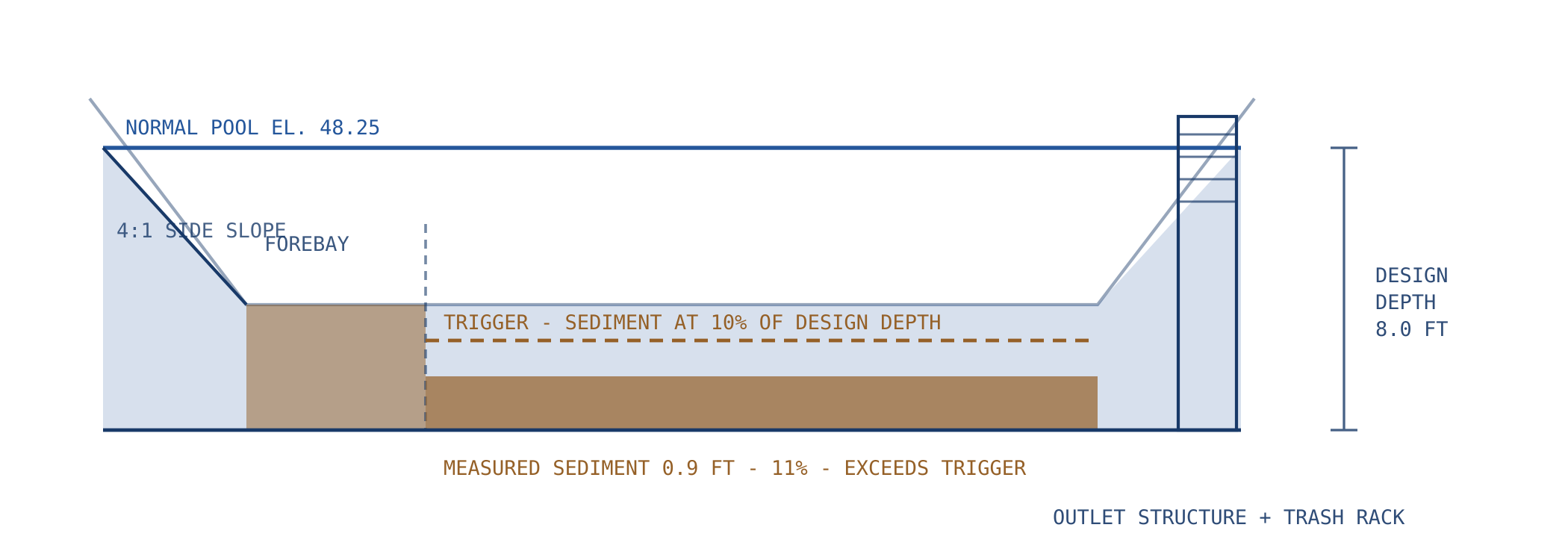
So the first visit measures rather than cleans: sediment depth on a grid, referenced to design depth from the approved drawings, or to surveyed bottom elevation where drawings are missing. That gives a percentage against the cleanout trigger – commonly 10% of design depth, paired in Seattle with a debris threshold near one cubic foot per 1,000 square feet.
02 / Maintenance strategy
A working forebay concentrates incoming sediment in a small, accessible cell. Cleaning it on a short cycle is far cheaper than dredging the main basin on a long one, and it is the highest-leverage line in a pond budget. Where the forebay is undersized, silted through, or was never built, we price the fix instead of absorbing it into a bigger dredge every few years.
03 / Findings
04 / Disposal
Dredged material is characterized where site history warrants, hauled under manifest, and documented in the closeout. On industrial and older commercial sites this is the part with the long liability tail.
05 / Reference
Cleanout trigger
10%
Sediment as a share of design depth
Baseline inspection
1×/yr
Annual minimum, plus post-storm
Forebay cycle
1-3 yr
Driven by the measured accumulation rate
Full basin dredge
7-20 yr
Deferred substantially by forebay maintenance
Local standardsThresholds and reporting differ by jurisdiction. See the market guides →
06 / Scope of work
Step 01
Grid measurement referenced to design or surveyed bottom elevation, with a plan showing where the material is.
Step 02
Access route, staging, matting, and protection of the outlet and downstream system.
Step 03
Mechanical or hydraulic removal, dewatering, staged loadout – sequenced so the basin keeps functioning.
Step 04
Outlet, riser, orifice and trash rack repair; regrading, armoring, turf re-establishment.
Step 05
Post-work survey, photos from fixed vantage points, disposal manifests, updated accumulation rate.
07 / Questions
It depends on the measured accumulation rate for that basin – a function of drainage area, upstream land use, and whether a forebay is catching the load. A maintained forebay is typically cleaned every one to three years and pushes full-basin dredging past a decade. An unmaintained basin on an active drainage area can hit its trigger in five to seven years. Two surveys a few years apart give you the real answer for your site.
Cost is driven by volume of material, access, dewatering and disposal – not pond size on paper. A forebay cleanout with good access is a small, predictable item. A full dredge with restricted access, wet material and characterized disposal is an order of magnitude more. We price from measured yardage, not a visual estimate.
Yes, and it is neglected more often because it looks like lawn. Dry basins accumulate sediment in the low-flow channel, lose outlet capacity, hold standing water when underdrains fail, and get regraded by mowing and landscaping. The permitted volume is just as real.